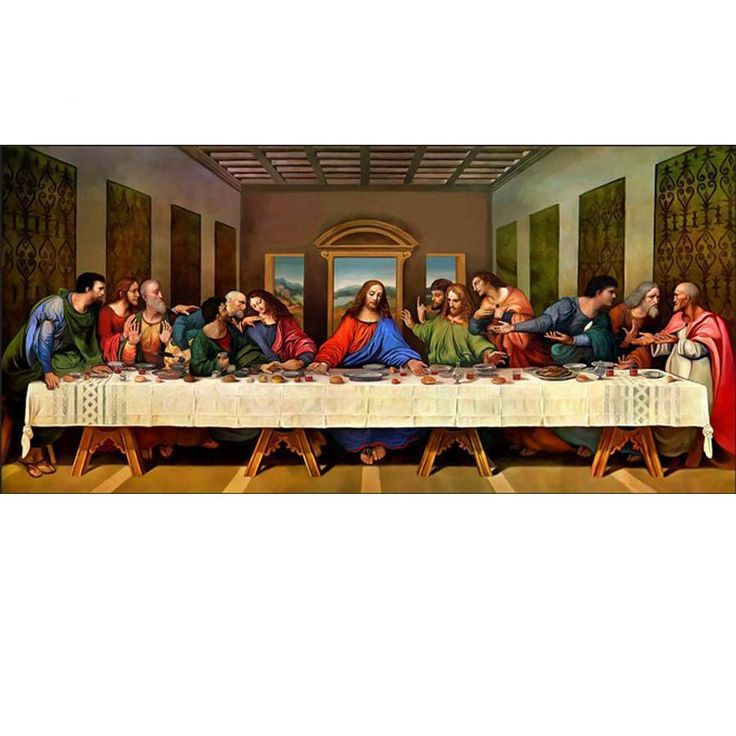

Maundy Thursday is a Christian holiday of great significance. Though not as extensively covered as before, you’re probably already aware of the holiday’s beginnings, particularly its connection to Holy Week. This holiday remembers the Last Supper of Jesus Christ before His crucifixion. Four days after marching through Jerusalem on a donkey, Jesus and His disciples prepared to celebrate the Feast of the Passover—itself a Jewish holiday remembering the Israelites’ liberation from Egyptian slavery. In this newsletter, I will recount the account for you.
Jesus ordered His disciples to prepare for the feast. He sent Peter and John into Jerusalem to find a man carrying a water jar, who would then lead them to the house where they would celebrate, known as the “upper room.” There, they would prepare the 15-step Passover meal. Interestingly, a man carried the water jug, a task typically performed by women at that time. This would have made the man very distinguishable in the crowd.
Jesus and the twelve disciples gathered in the upper room to eat the Passover meal. Unlike what one may expect, tensions were very high. The disciples were infighting about which of them was the greatest, showing their complete misunderstanding of Jesus’ mission, even mere days before His crucifixion. Further, this showed their lack of understanding of the character of Jesus: that of a servant. At this time, Jesus took a towel, poured water, and cleaned the disciples’ feet. This itself may seem bizarre in our culture, but it was representative of several major things: one, wearing sandals in a very dusty region results in filthy feet; two, this was the lowest servant’s task, and thus horribly shocking to see Jesus doing; three, this showed Jesus as a servant, which the disciples were blinded to through their haughtiness.
During the meal, Jesus took the unleavened bread, blessed it, broke it, and said, “This is my body, given for you.” He then took a cup of wine, saying, “This is my blood of the covenant, poured out for many,” and instructed them to partake in remembrance of Him. This, like most facets of this account, would have been especially jarring to the disciples. The process for the Passover meal was very specific, and this deviance would have been very significant to the disciples. Further, in Jewish culture, it was considered unclean to drink blood. Thus, Jesus referring to the wine as His blood would have been very weighty for the disciples. Jesus reframed the story to refer to Himself as the Passover lamb.
At this time, Jesus announced that one of His disciples was going to betray Him. This itself is an extremely shocking thing to reveal. As I reflected upon this account, I thought to myself, what might my reaction be if I were sitting at a table with people I was close with, and one of us announced with great authority that one of us would betray them? This is surely not a regular thing we experience. Most people would be awestruck. I find it safe to assume that shock would have ensued as Jesus subtly identified Judas, the group’s treasurer, as the betrayer, giving him a piece of dipped bread, a gesture of honor that doubled as a signal. Judas, instructed to move swiftly, left, an action interpreted by the others as an errand.
Adding to the immense shock of this evening, Jesus then warned the disciples that they would scatter, though the disciples still could not understand that Jesus would be killed very soon. Jesus told Peter specifically that he would deny him three times before the cock crowed, which Peter vehemently denied. Jesus told Peter, “Satan has asked to sift you like wheat, but I have prayed for you,” representing the fierce spiritual battle unfolding as Satan believed he would vanquish his enemy.
After the meal, Jesus delivered a lengthy teaching known as the Farewell Discourse. He spoke of His coming departure, the arrival of the Holy Spirit, the need for love and unity among His followers, and then prayed for the. The scene here is interesting: Jesus would have been under intense emotional weight (with His impending torture and death, Judas’s betrayal, and the spiritual war taking place), and the disciples were very confused as they struggled to grasp Jesus’ words about His death and return. While they sadly failed to grasp the meaning of His message to them at that time, it would later serve as a guidestone for them and Christians to follow. Before departing to the Garden of Gethsemane, they gathered and sang a hymn, likely the song of Hallel, drawing a stark emotional contrast between praising the Lord and Jesus’ coming agony.
After the hymn, Jesus led His disciples to Gethsemane, a garden on the Mount of Olives. There, He prayed in anguish while the disciples slept. This was a familiar spot to the disciples, as Jesus often met His disciples there. This also made Judas’s betrayal at the location very personal. It was here that Jesus was noted as being under such great emotional and mental stress that he sweated “great drops of blood,” a condition known as either hematidrosis or hematohidrosis, caused by the rupture of tiny blood vessels around sweat glands due to extreme stress. As He prayed in the Garden, Judas arrived with soldiers to arrest Him, marking the end of the account of Maundy Thursday.