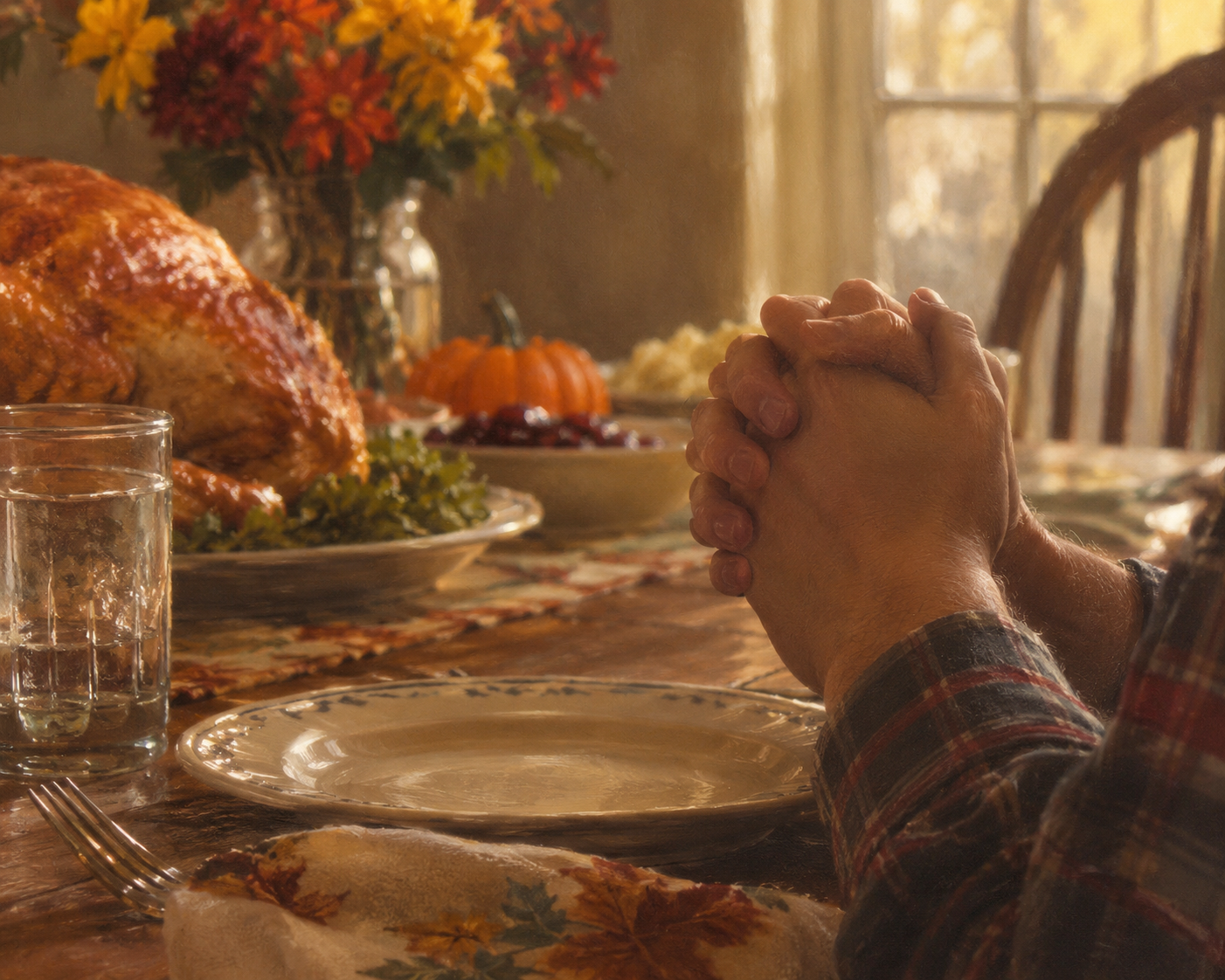

A Thanksgiving reflection for the weary, the downhearted, and all who find themselves carrying burdens this season.
There is a particular kind of anticipation that accompanies the arrival of Thanksgiving. The familiar preparations begin, recipes are brought out, homes are made ready, and families make plans to gather once more. There is comfort in these traditions: in the smells and sounds of a home preparing for company, in the familiar faces around the table, and in the opportunity to pause from the ordinary business of life and give thanks to God.
But the holidays have a way of reminding us of things, too.
For some, Thanksgiving brings memories of people who once sat at the table and no longer do, of those they wish were still in their lives, and of traditions that have changed with time. For others, it comes at the end of a year that has been anything but kind. There are those who have struggled to make ends meet, endured illness, watched relationships change, or spent much of the year praying for an answer that has yet to come.
And then there are those who cannot quite put their finger on what is wrong. They are simply tired. Tired of uncertainty, disappointments, and responsibilities that never seem to lessen. Perhaps they have spent the better part of the year doing what needed to be done, being strong for those around them, and pressing forward because there was little choice but to do so.
The world does not always see these burdens. A person can sit among family and friends, share a meal, exchange pleasantries, and wish everyone a happy Thanksgiving while quietly carrying a great deal more than anyone realizes. The mask they wear, however, is still a mask.
I suspect more of us know something of this than we care to admit.
We are accustomed to speaking of Thanksgiving as a celebration of our blessings, and rightly so. But what of the years when our blessings seem harder to find? What of the prayers that remain unanswered, the hopes that have gone unfulfilled, and the circumstances we would give anything to change? Are we to set aside our troubles for a day and pretend they do not exist? Or is there something deeper to this old tradition than simply counting the good things that have happened to us?
I believe there is.
For the Christian, as for the Pilgrims who came before us to this blessed land, thanksgiving is not dependent upon having a year worth celebrating. It is rooted in the goodness of the God who remains faithful through every season of life.
A Difficult Season Does Not Make a Faithless Heart
There is sometimes an unfortunate tendency to speak of gratitude as though it requires us to look upon every circumstance with a smile. We tell one another to count our blessings, look on the bright side, and remember that things could always be worse. There is truth in gratitude, but these words can become hollow when offered to someone who is genuinely hurting.
Not every burden can be set aside by changing our perspective. Not every loss can be made easier by finding something positive to replace it. The Scriptures do not teach us to pretend otherwise.
Consider David, whose Psalms give voice to some of the deepest expressions of sorrow and anguish found in the Bible. In Psalm 13, he cries out:
“How long wilt thou forget me, O LORD? for ever? how long wilt thou hide thy face from me?”
These are not the words of a man who has abandoned his faith. David brings his distress before the Lord. He does not conceal his anguish behind a rehearsed expression of gratitude.
Yet the Psalm does not end there. David concludes:
“But I have trusted in thy mercy; my heart shall rejoice in thy salvation.”
His circumstances are not suddenly resolved. His questions have not all been answered. But David remembers the character of the God to whom he has entrusted himself.
We need not pretend to be untroubled to remain faithful. We need not be ashamed of a heavy heart, or believe that a season of sorrow makes our gratitude less genuine. The Lord knows the burdens we carry, including those we have difficulty explaining to anyone else.
Sorrow, grief, and weariness are not mutually exclusive from thanksgiving. Often, our response to the former must be the latter as we move through life.
The Harvest Will Not Always Be Abundant
Perhaps no passage better captures the spirit of thanksgiving amid hardship than the words of the prophet Habakkuk.
He describes a harvest that has failed: the fig tree does not blossom, there is no fruit on the vines, the olive crop fails, and the fields yield no food. The flocks are cut off; the stalls stand empty. It is a picture of a people facing the loss of the very things upon which their livelihood depends.
And yet Habakkuk declares:
“Yet I will rejoice in the LORD, I will joy in the God of my salvation.” — Habakkuk 3:18
Consider the significance of that word: yet.
Habakkuk cannot rejoice in fields that are full, a harvest restored, or difficulties taken away. Yet, despite what he sees before him, he will rejoice in the Lord.
There is a world of difference between giving thanks when everything has gone according to plan and giving thanks when it has not. One comes naturally with abundance; the other requires us to remember that our hope was never meant to rest entirely upon the abundance of this world.
Some years our harvests are plentiful. Others leave us wondering whether we should continue to labor. We work toward something, pray for something, and make plans for a future that does not always unfold as we imagined. Sometimes we find ourselves looking back upon a year and asking where the plans for our lives have gone, or whether the toil is worth it.
But does the failure of the harvest mean the goodness of God has failed?
Of course not.
The Lord is not made faithful by our prosperity, nor does His goodness disappear when our circumstances become difficult. We may not know why certain doors have closed, why certain prayers seem unanswered, or why some burdens weigh more than we feel prepared to carry. But we can know the One who remains with us through them.
Consider Joseph. His brothers sold him into slavery; he was later falsely accused and thrown into prison. Yet God raised him to a position of authority in Egypt, through which he was able to save many during a devastating famine. What was meant for evil, God used for good.
As Joseph said:
“But as for you, ye thought evil against me; but God meant it unto good, to bring to pass, as it is this day, to save much people alive.” — Genesis 50:20
Joseph’s story does not make the betrayal, slavery, or imprisonment any less terrible. But it reminds us that the intentions of those who wrong us do not place limits upon what God can accomplish. What appears to be the end of one chapter may become the beginning of something we could not have foreseen. We may not be given the explanation in this life, but that does not mean the Lord has ceased to work.
There Is Still Mercy for the Weary
The God who calls His people to give thanks is also the God who cares for the brokenhearted.
Isaiah reminds us that the Lord “giveth power to the faint; and to them that have no might he increaseth strength” (Isaiah 40:29). The Psalmist writes, “The LORD is nigh unto them that are of a broken heart” (Psalm 34:18).
And among the most comforting words spoken by our Savior are these:
“Come unto me, all ye that labour and are heavy laden, and I will give you rest.” — Matthew 11:28
Christ does not extend this invitation exclusively to those who have their lives in order, those who are successful and worry-free. He calls the weary and the burdened: those who have labored, struggled, and reached the limits of their own strength.
We spend so much of our lives trying to hold things together. We have families to care for, work to accomplish, obligations to fulfill, and people who depend upon us. When seasons become difficult, we press on, telling ourselves that tomorrow will be better, that the next season will be easier, and that the things we have been working and praying for will surely come to pass.
Sometimes they do. Other times they do not. And sometimes the waiting itself becomes a harder row to hoe.
Let us remember the Pilgrims, those who had truly lost so much. Forced from their homeland by persecution, they endured a perilous voyage across the sea into a strange and distant land. By the time of the first Thanksgiving, roughly one in every two Pilgrims was dead. And yet William Bradford wrote, “the Lord is never wanting unto His in their greatest needs; let His holy name have all the praise”—the Lord does not abandon His people in their greatest needs; let His name be praised.
The first Thanksgiving was not the product of a people spared hardship, nor was it a celebration held by those whose every hope had been fulfilled. They endured suffering most of us can scarcely imagine, and yet they found reason to give thanks. Their gratitude did not depend upon the absence of affliction, but upon the God who had sustained them through it.
Perhaps you, reader, find this year leaving you weary and downhearted. There is no discounting that, nor ought there be. Yet remember that we were never meant to bear every struggle alone. If you find yourself nursing your wounds this season, take heart: you are never alone, and your grief does not distance you from the warmth of His enduring mercy. A closed door is painful, but sometimes a window opens where we least expect it, becoming a beacon of hope.
The Lord has not promised us a life without affliction. But He has promised His presence, His mercy, and the rest that can only be found in Him. His mercies, as Jeremiah reminds us, “are new every morning: great is thy faithfulness” (Lamentations 3:23).
What a wonderful truth to carry into Thanksgiving.
What We Have, and What We Have Not Lost
In 1 Thessalonians 5:18, the Apostle Paul instructs:
“In every thing give thanks: for this is the will of God in Christ Jesus concerning you.”
Consider the subtle yet crucial distinction: he does not urge us to be thankful for every heartache, injustice, or burden, but to cultivate gratitude in every circumstance.
Giving thanks does not require us to glorify our pain, excuse wrongdoing, or abandon the longing for things to improve. True gratitude never asks us to forfeit our hope for brighter days. At the same time, we must take care not to let life’s trials blind us to the quiet blessings that endure.
Though people may scorn us and our circumstances may weaken us, none of these things own us. Our circumstances do not define us, people do not own us, and our struggles do not change who we are. We can refuse to let these things destroy us, taking them in stride, even in weakness, and pressing toward what is still to come. We choose who we are through the Lord’s will.
There may still be a home to be thankful for, however modest. There are people who care, even if some are far away. There is food upon the table, the changing of the seasons, the warmth of a fire, and the opportunity to begin another day. There are kindnesses we have received, prayers that have been answered, and blessings so familiar that we scarcely stop to acknowledge them.
And for those who belong to Christ, there is something greater still: the promise of salvation, the forgiveness of sins, the hope of eternal life, and the assurance that neither tribulation, distress, persecution, nor any other power can separate us from the love of God.
The world measures a good year by what we have gained, what we have accomplished, and how closely our lives resemble the future we imagined. But the Christian has a different measure. Our circumstances may change, our plans may be frustrated, and things we once counted upon may be taken from us. Yet the foundation of our hope remains.
We may have lost something precious without losing everything. We may be waiting for an answer without being abandoned. We may be walking through a difficult season without walking through it alone.
And sometimes, when there is little else we can make sense of, that is reason enough to give thanks.
Remember One Another
As we gather this Thanksgiving, there is one more thing I hope we will remember.
Not everyone sitting around the table is arriving from the same place. Not everyone has had a good year. Some may be quietly grieving; others may be facing difficulties they have not shared. There may be someone among us doing everything they can simply to keep going.
There is another burden that deserves our attention: loneliness. Not simply the quiet of an empty house, but the loneliness of feeling forgotten, of watching others gather with the people they love while wondering where you belong. For some, the empty chair belongs to someone who has passed on. For others, it belongs to someone still living, but no longer present in their lives. There are those who will sit at a crowded table and still feel entirely alone, and those who will spend the day wishing they had a table to sit at in the first place.
It is a peculiar cruelty of the season that a holiday centered around gathering can make the absence of companionship all the more difficult to bear. Some have watched a home change, a relationship fall apart, a friendship fade, or a future they once imagined slip beyond reach. Others have no family nearby, no invitation waiting, or no one who realizes how much they would appreciate a little company.
Let none of us be so consumed with our own festivities that we fail to see them.
We ought to be generous with our patience, slow to judge, and willing to extend a little kindness. Our families and communities are not strengthened by demanding that everyone appear happy, but by making room for one another through good seasons and difficult ones alike. An invitation, a conversation, or a little consideration may mean more to someone than we could ever know. We need not know every detail of another person’s burdens to treat them with compassion.
And if you are among those who find this Thanksgiving more difficult than most, I hope you will not mistake your circumstances for the absence of God’s goodness. You need not have all the answers. You need not have reached the place you hoped to be. You need not pretend that everything is well.
Come to the table, if there is one waiting for you. If there is not, do not believe that your absence from someone else’s gathering means you have no place in this world. There are people who would welcome the opportunity to extend a hand, and sometimes the first step toward finding them is allowing yourself to be seen. Your present circumstances are not the measure of your worth, and the people who are absent from your life do not determine the love and fellowship still possible in the years ahead.
The year may not have gone as you planned. Far more people feel this pain than you realize. Where the road ahead may lead is uncertain. But the same God who sustained His people through wilderness, famine, exile, and affliction has not ceased to be faithful.
The first Thanksgiving was not born out of a perfect year, and neither is our own gratitude dependent upon one. We give thanks because God is good, not because every circumstance is.
For those who find themselves in a difficult season, may you remember that the Lord is near, His mercy is not exhausted, and your present circumstances are not the end of your story.
The harvest may fail. The road may be difficult. The heart may be weary. Yet the Lord remains faithful.
There is always a chair waiting for you somewhere.
Even here, give thanks.