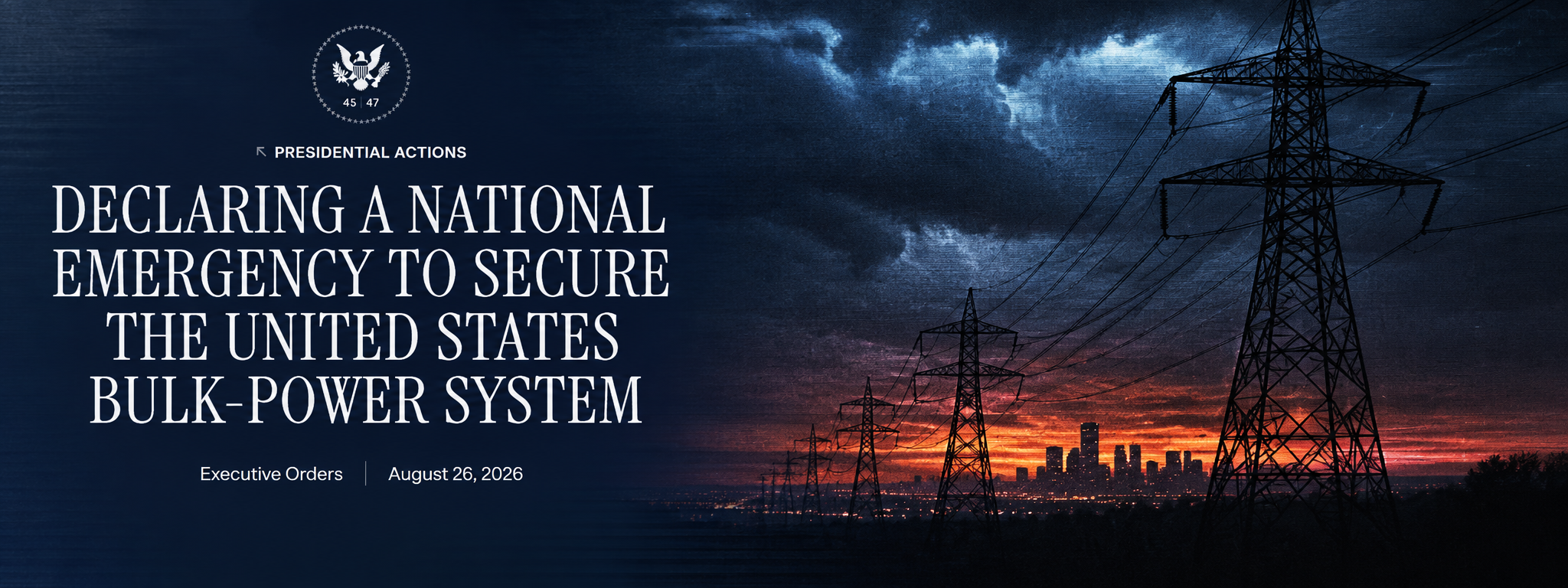

On August 26 he signed Executive Order 14420, declaring that foreign-produced equipment in the United States bulk-power system is an “unusual and extraordinary threat” to national security, foreign policy, and the economy. The Department of Energy can now block new foreign gear from entering the high-voltage system—and, where the risk is judged unacceptable, isolate or order the removal of equipment already sitting in substations and generating stations.

This is not a blackout order. It is not a ban on every imported bolt. It is an IEEPA emergency aimed at transformers, inverters, battery systems, protective relays, industrial control systems, firmware, and remote-access paths that can be built with a digital backdoor—or simply cut off when a foreign supplier decides the spare parts stop.
The White House says the danger has grown since Trump’s first-term bulk-power order because the country now hangs more of its future on bulk electricity: advanced manufacturing, data centers, artificial intelligence, and defense production. A successful hit, or a supply cutoff, would no longer be a regional inconvenience. It would be a national wound.
What EO 14420 puts on the
After August 26, a new acquisition, import, transfer, or installation of foreign-produced bulk-power equipment can be prohibited if Energy—working with OMB, War, Commerce, Homeland Security, and the Director of National Intelligence—finds two things.
First, the hardware or the software, firmware, digital service, maintenance, or remote-access capability tied to it comes from a person owned, controlled, or directed by a Covered Foreign Entity.
Second, the deal poses an undue risk of sabotage, unauthorized access, malicious remote action, or supply disruption; a catastrophic risk to critical infrastructure or the economy; or an otherwise unacceptable risk to the national security of the United States.
A Covered Foreign Entity is a country or person under a U.S. arms embargo or ITAR sanctions regime—or a party Energy later designates as hostile to American security. The order does not name China. The category does. Russia, Iran, and North Korea sit in the same legal bucket. They do not build our substations. China does.
Gear already installed is not safe by age. Energy can order it identified, isolated, monitored, disconnected, replaced, or removed. Before a rip-out, the Secretary must weigh reliability, safety, and whether a secure replacement even exists. Rules are due in 120 days. An inventory of risky foreign equipment already on the system is due as soon as practicable.
This covers the bulk-power system: transmission at 69,000 volts and above, and the generation needed to keep that network standing. It does not cover local distribution. The last mile to a farmhouse is not the target. The control room is.
The weather around the order
Three days before the signature, Ontario Premier Doug Ford put American-bound electricity “on the table” in the tariff war. He said Ontario powers about 1.5 million U.S. homes and businesses. New York, Michigan, and Minnesota take the blow first. By Wednesday he was talking surcharge before cutoff, and saying he would not move alone. That is still a knife at the intertie.
The same week, Reuters reported Chinese hackers inside the Justice Department, NASA, the Federal Reserve, and the Senate. Fox reported Iran-linked actors suspected in a U.K. power-plant incident after a Minnesota water-system campaign already tied to Tehran. Those stories are not the executive order. They are why the order does not read like theater.
Thursday, Jones opened his live show on 14420 and cut a 17-minute breakdown holding the printed White House text against a Telegraph report on CIA Director John Ratcliffe warning Vladimir Putin not to strike NATO. Then he put a World Economic Forum page on screen: “A cyber-attack with COVID-like characteristics?” His charge is simple. The emergency does not only police Chinese transformers. It pre-positions the legal wrapper for a mass cyber and power event that will be blamed on China, Iran, or Russia.
Wargame the Order
The first live case is the backdoor that is already there. The professional use of compromised inverters, relays, and remote-support channels is not a noon button in Beijing that drops Ohio. It is access mapped for years and pulsed in a crisis—Taiwan, sanctions, a wider war. The order matters if Energy inventories the boxes before that day. If the 120-day rules are paper and the inventory is a memo, the installed fleet stays live and 14420 is only a future-procurement screen. If Energy starts isolating defense-adjacent 69-kV corridors, the next fight is whether America can even build the replacements. Transformer lead times are measured in years. A security win that creates a spare-parts famine is still a loss.
The second live case is Canada. Ford’s lever is regional price and adequacy, not a continental kill switch. Pair a surcharge or a coordinated cutoff with a freeze on Chinese-origin utility gear and the remaining allied queue gets bid up. Rates move first. Outages move if weather hits the same week. Ohio sits in PJM. This is not theoretical load.
The third live case is the one Jones is naming. A multi-region control-system or substation event hits. The first podium names China, Iran, or Russia. The emergency already on the books is used to accelerate rip-and-replace and widen who counts as a Covered Foreign Entity. That named state may have done it. A proxy may have spoofed it. A third party may have used the crisis. A republic that accepts the name without packet logs, vendor logs, and an unclassified damage board has decided the name is the policy.
The WEF “cyber pandemic” language is real and old. Globalist shops have gamed COVID-style cyber response for years. Executive Order 14420 is not that paper. Watch what gets hung on it after an incident. Vendor lists and equipment bans are the order as written. Speech rules, financial locks, and movement controls would be a different document wearing this one’s clothes.
Even with no attack, 14420 is industrial policy. Federal projects will be pushed toward American-made energy infrastructure. Utilities that want a clean interconnection will pre-clear vendors. The origin fight on firmware will be dirtier than the origin fight on steel.
The next 120 days
Watch who Energy lists beyond the embargo schedule. Watch whether the first prohibition hits inverters and control software or only large transformers. Watch whether any existing substation is ordered isolated. Watch Ford’s surcharge on the northern interties. Watch whether the next attributed cyber incident is used to enforce 14420—or to stack a second emergency on top of it.
The grid is a warfighting asset. Saying so out loud is overdue. The page that was signed is a foreign-equipment screen with removal authority. The page that gets written in the first 72 hours of a real event is the one that decides whether this emergency stays on the hardware—or becomes the wrapper for everything else. That is the wargame. The American people should watch both documents.
You must be logged in to post a comment.