
Written by: Marie Dargenteau
Marie Dargenteau is a European mother of three boys with twenty years of experience in law enforcement, specializing in criminal intelligence and international police cooperation. Her work has taken her beyond Europe, including training assignments in Africa and exchanges with professionals from across the continent. Alongside her professional work studying risk, behavior, networks and institutional fragility from the inside, she has spent years reflecting on a more intimate question: how families can organize their lives with greater meaning, resilience and continuity. She is currently writing Permadomaine, a book about family, place, autonomy and intergenerational transmission, while preparing with her family to build a first family-scale model of the concept: a living compound designed around privacy, resilience and continuity.
In popular imagination, the term “family compound” often evokes a very specific image: a coastal estate in New England, a cluster of vacation homes around a lake, or a wealthy family retreat hidden behind trees and long driveways. Yet this image hides an older, more practical history. Long before it became associated with wealth, privacy, and inherited land, many families lived in organized rural complexes where home, work, food production, storage, care, and transmission were physically connected.
The European mixed farm, the colonial homestead, the ranch, the Appalachian farmstead, and the multigenerational rural property all share a common logic: the family home was not just a place to sleep. It was a productive, relational, and economic unit. Before the compound became a symbol of status, it was a structure of continuity. Traditional mixed farms in Europe and elsewhere often required several buildings because farming combined crops, animals, tools, storage, and household production.
In Pennsylvania, farm historians have shown how barns, smokehouses, root cellars, workshops, spring houses, granaries, and poultry houses reflected diversified family economies, not decorative nostalgia. The modern family compound can be read as a contemporary descendant of that older logic. Not a replica. Not a museum. A translation.
Why is the family compound returning now?
The renewed interest in family compounds is not surprising. American life has become more expensive, more mobile, and more fragmented. Housing costs have pushed many young adults into delayed independence, shared housing, or a return to the parental home. Pew Research Center found that one quarter of U.S. adults aged 25 to 34 lived in a multigenerational family household in 2021, compared with 9 percent in 1971. Pew also found that financial issues are the leading reason adults give for living in multigenerational households.
This does not mean young adults want to remain children. It means the isolated household is becoming harder to sustain. At the same time, there is a visible cultural search for slower, more grounded, and more meaningful ways of living. Among younger generations, especially Gen Z and younger millennials, this often appears in digital form first: cottagecore, garden aesthetics, homesteading content, slow living, DIY skills, food preservation, visible domestic crafts, and renewed interest in land-based practices. Some of these trends are superficial. Some are highly aestheticized. Some are shaped by social media algorithms. But beneath the styling, they point to something real: a desire to reconnect daily life with visible production, family memory, nature, craft, food, and continuity.
A 2024 academic article on cottagecore describes Generation Z as a potential audience for rural and agritourism experiences shaped by the cottagecore aesthetic. Gardening surveys have also suggested that younger gardeners are particularly interested in expanding their gardens and spending more time on them. The interesting point is that this revival is not anti-technology. It is often built through technology. A young person may discover sourdough through TikTok, learn pruning on YouTube, sell handmade goods online, work remotely from a rural property, manage a greenhouse with sensors, or run a digital business from a converted barn.
This is not a simple return to the past. It is a search for traditional structures, updated with modern tools.
What is a family compound, really?
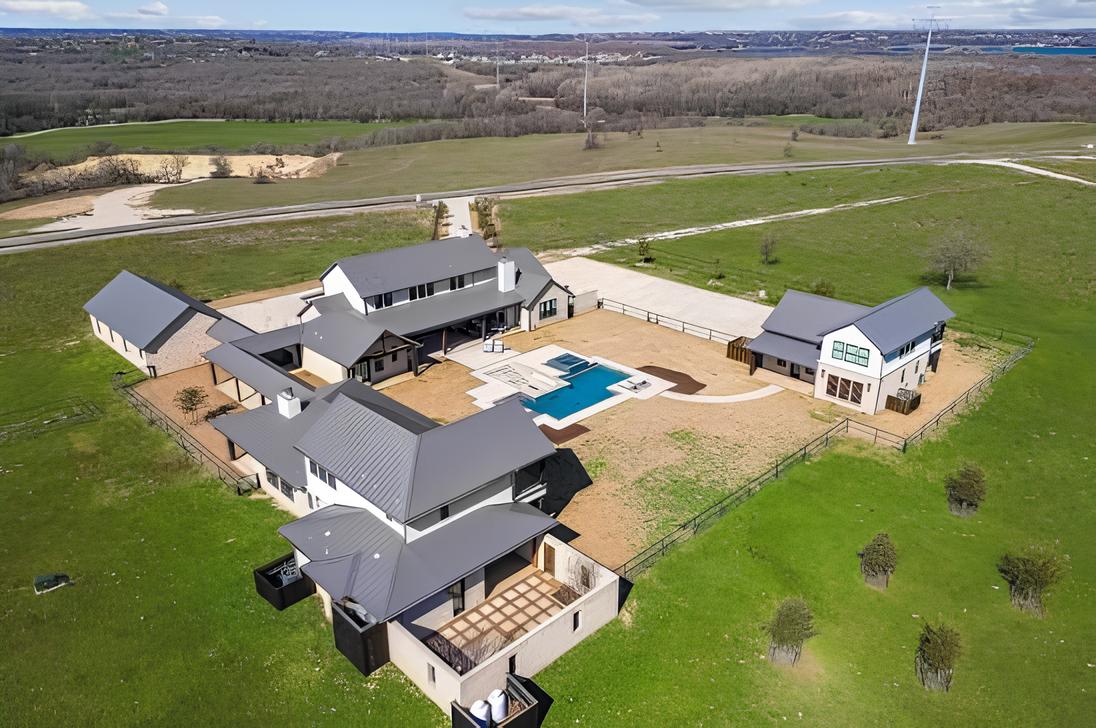
A family compound is not just several houses on one property. It is a designed environment where related households live near one another while sharing some resources and preserving private life. That distinction matters. Without privacy, proximity becomes pressure. Without shared functions, the compound becomes merely a cluster of houses.
A good compound answers practical questions:
Where does each household retreat?
Where do people gather?
How do children move safely between homes?
Can grandparents participate in daily life without being constantly invaded?
Where are tools stored?
Where do deliveries arrive?
Can one person work quietly while others host a family meal?
Can teenagers have independence without being disconnected?
Can aging parents remain close without losing dignity?
Architecture matters here. So do paths, thresholds, doors, windows, parking, sightlines, sound insulation, and distance. A family compound designed only around togetherness will fail. It must be designed around privacy first, then connection.
This is one reason accessory dwelling units, guest houses, converted barns, secondary cottages, and clustered housing models are becoming more relevant. AARP notes that multigenerational living works best when it creates opportunities for interaction across generations, while accessory dwelling units can provide independent living space on the same property.
The old farmstead understood this intuitively. Work areas, domestic areas, animal areas, storage areas, orchards, gardens, wells, and paths had to be arranged coherently. The Parker-Hickman farmstead in Arkansas, documented by the National Park Service, included a log house, barns, sheds, fields, springs, roads, fences, garden plots, and orchard plots. Together, these features formed a productive landscape, not just a residence. The modern compound needs the same seriousness of design.
Why privacy is the central condition
The greatest misunderstanding about multigenerational living is that it requires constant togetherness. It does not. In fact, the opposite is true. The more generations live near one another, the more carefully privacy must be protected. A compound should allow closeness without surveillance. Support without intrusion. Shared meals without forced intimacy. Help without dependency.
Each household needs its own door, its own rhythm, and ideally its own outdoor threshold. The family can share infrastructure, but not every moment. The success of a compound depends less on the size of the property than on the clarity of boundaries.
Privacy is not individualism. It is what makes long-term proximity possible.
What are the economic advantages?
The economic case for the family compound is becoming more relevant, especially for younger generations. A compound can reduce duplicated costs. Instead of every household purchasing every tool, every appliance, every vehicle, every guest room, every workshop, every child-care solution, and every emergency reserve separately, some functions can be shared.
This does not eliminate the need for income. It does not make housing free. It does not remove conflict. But over time, it can change the economic structure of family life.
For younger adults, the benefits can be significant. A compound may offer a lower-cost first home, a place to build savings, access to family help with children, shared maintenance, or the ability to test a business without carrying the full cost of separate infrastructure. For older adults, it may offer proximity, safety, participation, and a way to age near family without moving into an institution too early.
Research on multigenerational households already shows financial buffering effects. Pew found that Americans living in multigenerational households are less likely to be poor than those in other household types. AARP also notes that intentional multigenerational living can reduce loneliness, support caregiving, and create savings on expenses such as rent and childcare. The compound extends this logic spatially. It turns family support into design.
Why governance matters as much as architecture
A beautiful compound can still fail. The reason is rarely architectural alone. It is usually governance.
Who owns the land? Who pays for maintenance? Who decides whether a new structure can be built? Can an adult child return after divorce? Can a cousin live there? Can a member sell their share? Who manages shared equipment? What happens when one household contributes more money and another contributes more time? Who cares for aging parents? Who resolves disputes?
These questions are not romantic. They are essential. A family compound cannot rely only on affection. Love may initiate the project, but rules preserve it. The more valuable the land becomes, the more important the rules become. Without governance, the compound risks becoming a future inheritance dispute with nice landscaping.
This is why the revival of the family compound should not be treated as a lifestyle trend alone. It is a serious intergenerational design problem. It requires land-use planning, architectural intelligence, financial realism, legal clarity, and family culture.
What should be transmitted?
The most obvious answer is land. But land is not enough. A family can inherit property and still lose the system that made it meaningful. What truly matters is the transmission of use, skill, memory, responsibility, and adaptability. A compound should not be designed merely to keep descendants on the same land forever. It should give them a stronger starting point, a deeper memory, and a more resilient structure from which to choose their lives.
The best family compound is not a cage. It is a platform. Some will stay. Some will leave. Some may return. Some may build elsewhere using the same principles. The point is not to freeze a family in place. It is to restore continuity where modern life has produced isolation.
From estate to infrastructure
The family compound deserves to be rethought. Not as a luxury estate. Not as a nostalgic fantasy. Not as a retreat from society.
At its best, it is a practical response to some of the pressures shaping modern life: housing costs, loneliness, aging, childcare, fragile careers, loss of practical skills, and the difficulty of transmitting more than money.
Its historical roots are rural, but its future may be hybrid. A modern compound may include remote work, digital businesses, solar systems, shared workshops, food production, elder care, online education, guest housing, and small-scale enterprise. It may look like a farm, a cluster of cottages, a renovated suburban lot with an accessory dwelling unit, or a rural property with several households and shared infrastructure.
Context matters. The form can vary. The deeper question remains the same: how can a family organize place, privacy, work, care, and transmission across more than one generation?
These are not questions with universal answers. But they are questions every family eventually faces, whether consciously or not. How much independence do we really want? What should we share? What should remain private? What do we hope to transmit? What kind of place can support the lives we are actually trying to build?
No model can answer this in the abstract. Each family has to find its own balance, according to its history, means, relationships, and hopes for the next generation.
Source notes
Axiom Marketing, 2024 Gardening Outlook Survey, reported via Business Wire and Garden Center Magazine: Gen Z and Gen Y respondents showed strong intentions to spend more time gardening and expand gardens.
https://www.businesswire.com/news/home/20231031325725/en/Axiom-Releases-Annual-2024-Gardening-Outlook-Survey
https://www.gardencentermag.com/article/2024-gardening-outlook-survey-garden-centers-spring-survival-guide-axiom/
Britannica, “Farm building” and “Mixed farming”: mixed farms in European agriculture and elsewhere traditionally include several service buildings for machinery, livestock and crop storage.
https://www.britannica.com/topic/farm-building
https://www.britannica.com/topic/mixed-farming
Penn State, “How Pennsylvania farm buildings tell the state’s agricultural history”: Sally McMurry explains that Pennsylvania farms used multiple outbuildings because diversified farms combined many types of production and local trade.
https://www.psu.edu/news/research/story/how-pennsylvania-farm-buildings-tell-states-agricultural-history
Pew Research Center, “Multigenerational living is growing fastest among young Americans”: the share of U.S. adults aged 25 to 34 living in multigenerational households rose from 9 percent in 1971 to 25 percent in 2021.
https://www.pewresearch.org/short-reads/2022/07/20/young-adults-in-u-s-are-much-more-likely-than-50-years-ago-to-be-living-in-a-multigenerational-household/
Pew Research Center, “Financial Issues Top the List of Reasons U.S. Adults Live in Multigenerational Homes”: 59.7 million U.S. residents lived in multigenerational households in 2021; Pew discusses financial reasons and lower poverty levels.
https://www.pewresearch.org/social-trends/2022/03/24/financial-issues-top-the-list-of-reasons-u-s-adults-live-in-multigenerational-homes/
AARP Policy Book, “Multigenerational Living”: intentional multigenerational living can support interaction, reduce loneliness, support caregiving and create savings on rent and childcare.
https://policybook.aarp.org/policy-book/housing/other-housing-topics/multigenerational-living
AARP, “Accessory Dwelling Units — What They Are, What They Can Do”: ADUs are self-contained living spaces on the same lot as a larger single-family residence.
https://www.aarp.org/livable-communities/housing/adus/accessory-dwelling-units-factsheet-download.html
National Park Service, “Parker-Hickman Log Cabin & Farm Cultural Landscape”: documented farmstead with log house, barns, sheds, fields, springs, roads, fences, garden plots and orchard plots.
https://www.nps.gov/articles/000/parker-hickman-log-cabin-and-farm-500852.htm
Sierpie? and Tucki, “Cottagecore as an idealisation of rural life and a new dimension of tourist activity for Generation Z in rural areas,” Prace Geograficzne, 2024.
https://ejournals.eu/en/journal/prace-geograficzne/article/cottagecore-as-an-idealisation-of-rural-life-and-a-new-dimension-of-tourist-activity-for-generation-z-in-rural-areas