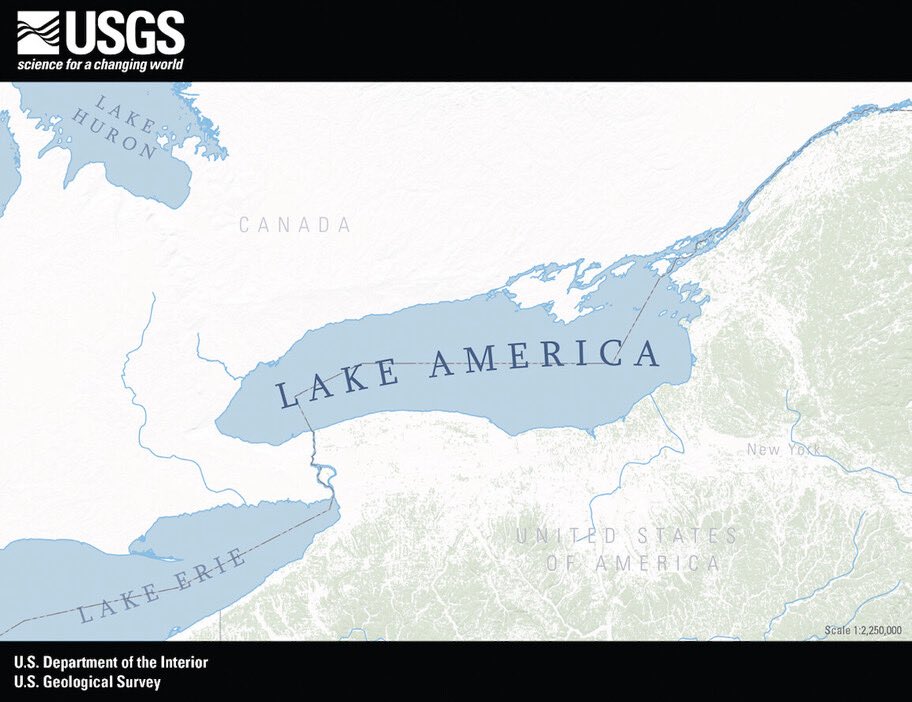

Changing the Gulf of Mexico to the Gulf of America worked. It was unexpected. It had a real claim. It landed in a season when the second Trump term still felt like it was on offense. People remembered it because it felt like assertion, not reaction.
Lake America is the opposite. It is reactionary. It is timed to a trade spat and a midterm calendar that already looks ugly. It solves none of the actual problems Americans are living with. And it treats a four-century American name as if it were a Canadian possession we finally seized.
Matt Walsh is right on the history, and the history is the whole point.
“Ontario” is not a Canadian invention. It is an Iroquoian word—commonly rendered “beautiful lake” or “lake of shining waters”—that European mapmakers were already using in the 1600s. The province of Ontario was named for the lake in 1867. The lake was not named for the province. There are American towns called Ontario that predate the Canadian province by decades. The name belongs to the people who lived on these waters and to the maps that recorded them long before Confederation. Canadians never uniquely owned the word. By striking it out and writing “America” over it, we are the ones treating the name as if it were theirs to begin with.
That is the opposite of dominance. It is a concession dressed as a troll.
The Gulf change had a different texture. “Mexico” in that context was a national label on a body of water whose American shoreline and economic weight are obvious. “Ontario” is a place-name that already sits inside American geography and American history. Erasing it does not plant a flag. It deletes a marker that was already ours.
There is also the problem of the word itself. I love the name America. That is why it should not be sprayed on everything. When every body of water, every department, every gesture gets the same stamp, the stamp loses weight. Originality matters. Lake Jefferson. Lake Washington. Lake Adams. Lake Joseph Warren. Lake Revere. Those would have been arguments about inheritance. “Lake America” is an argument about a press conference.
It will not stick. Federal maps and USGS databases can be updated in thirty days. Canadian maps, provincial governments, shipping charts, weather reports, and ordinary speech will not follow. New York will not follow. The people who live on the lake will not follow. The same pattern we already saw with the Gulf will repeat, except this time the underlying name has deeper roots on both sides of the water and a weaker claim that the change was ever necessary.
Worse, the timing is the tell. This lands in the lowest stretch of the term so far—tariffs escalating, talks collapsed, midterms approaching—and is being sold as a victory. Symbolic fights are fine when they are secondary. They become a problem when they are treated as the main event while prices, borders, and actual leverage go unaddressed. Canadians will keep calling it Lake Ontario. A large share of Americans will too. The only lasting effect is that we spent political capital advertising a grievance instead of solving one.
The Great Lakes were never a prize to be renamed in a fit of pique. They are a shared system governed by treaties, commissions, and two centuries of practice. You can dislike Ottawa’s trade posture without pretending a 17th-century Iroquoian name on a French map is an insult that must be answered with a Sharpie. That is not strength. It is the tell that the administration is reaching for theater because the harder work is not landing.
Gulf of America had the element of surprise and a cleaner case. Lake America has neither. Keep the name that was already American. If you want a fight with Canada, fight over steel, dairy, energy, and the border. Do not spend the afternoon crossing out a word that was never theirs to begin with.
We were promised Greenland; instead we got a renamed lake.