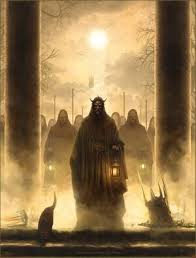
Tolkien began a sequel to The Lord of the Rings called “The New Shadow.” He wrote around 13 pages before he quit altogether.
The story was one of Satanism—the occult that men fell into.
He deemed it far too dark and sinister to delve into.
“I did begin a story placed about 100 years after the Downfall, but it proved both sinister and depressing. […] Since we are dealing with Men it is inevitable that we should be concerned with the most regrettable feature of their nature: their quick satiety with good. […] I found that even so early there was an outcrop of revolutionary plots, about a centre of secret Satanistic religion; while Gondorian boys were playing at being Orcs […] I could have written a ‘thriller’ about the plot and its discovery and overthrow — but it would have been just that. Not worth doing.” The Letters of J.R.R. Tolkien.
Many ask why he did not change the story, write a different path. After all, is he not the author of the story?
But it is within that question where the answer lies: No, he is not the author of the story.
To understand The Lord of the Rings, The New Shadow, or any of the other works by Tolkien, you must know what they are—and what they are not.
They are not fantasy tales. They are not mere fiction for the amusement and entertainment of the reader, as many works are. Rather, they are the narrative of God and mankind, transposed into fantastical literary form.
Everything he wrote was about the nature of man, the history of the world, the acts of God, the saving grace of our Lord, philosophy, theology, and the Bible. The war between good and evil. Be it directly or indirectly, this is what the Middle-earth legendarium was.
This brings us back to The New Shadow.
Why could he not change the story? Because, wisely, Tolkien knew he could not change the future of mankind, nor their nature. And, as his stories were about mankind, he must simply record man’s tale.
Simply, Tolkien could not change the sinister and Satanic plot he found postdated the War of the Ring because it was the future for mankind that he saw unfolding, and that had unfolded before his time and then before his eyes.
The story opens with an old man, Borlas (son of Beregond from The Lord of the Rings), debating a younger man, Saelon, over childish mischief that hints at deeper malice—wasting unripe apples not from need, but from spite. This spirals into whispers of the “Dark Tree,” a symbol of evil’s deep, ineradicable roots in human hearts, and a figure named Herumor leading shadowy cults. Tolkien saw this not as invention, but as inevitable: humanity’s boredom with virtue would always invite darkness back in.
The few pages we have of this story—to the modern world—likely do not seem dark or sinister in the least. Perhaps they would view it as bleak or dreary, lacking the heroism of the former tales. But I doubt most would sense the darkness, the heaviness, the Satanic grip that is upon it, much as they miss this from the former stories of The Lord of the Rings, The War of the Last Alliance, and the stories from the first antagonist, the parallel to Satan, Morgoth.
In reality, the opening pages are but the first glimpse into a much darker world, a spiritually Satanic story. A story much like the one we ourselves delve into. On the surface, all seems well (panem et circenses, if you will). “Innocence,” they call it; “adolescence.” But behind the veil of simple acts of wrongdoing lies a horde of pure, writhing evil.
So better, Tolkien saw it, to simply not record the darkness that he uncovered, and dedicate his time to fairer things, than to record the true evil that became mankind. And this evil is truly the darkest and heaviest evil ever become unto men, as Tolkien well knew.
As an author and writer myself, and one who has witnessed such evils, I can say writing of such evil is truly the most wrenching thing man can do. It is as if it is an abomination to our bodies. It would have wrecked Tolkien to do so, if not in mind than in body. Tolkien himself called the tale “both sinister and depressing,” noting that he could have turned it into a mere “thriller” about uncovering and overthrowing the plot, but it would be “just that. Not worth doing.” He chose instead to leave it unfinished, preserving the hope and eucatastrophe of his greater legendarium rather than dwelling in unrelieved shadow. And, sadly, there would be no bright end to the tale, but further darkness.
“It will be like the Days of Noah.”
Comments